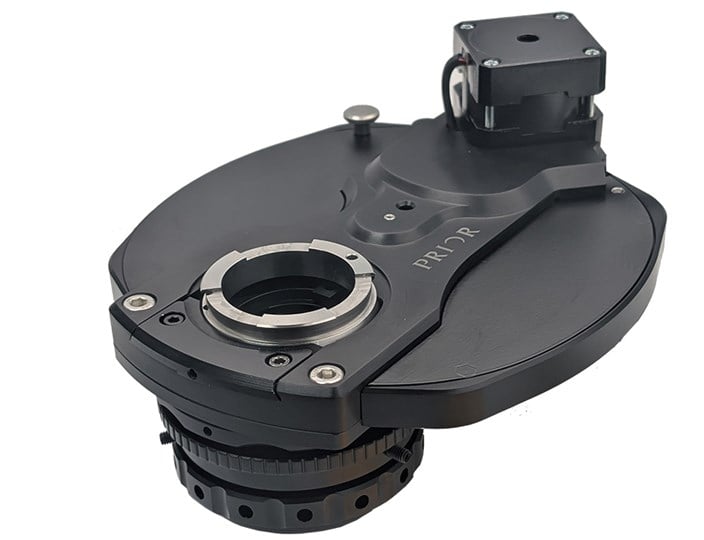
Adaptive Autofocus Empowers Microscopy: A Technical Overview
16.12.24
Microscopy continues to evolve with advancing technology, and automated focusing systems have become crucial for various applications. This article explores how hardware-based autofocus systems work and how Prior Scientific is advancing the technology to accommodate new sample types, including microfludics, in research and industry.
It is based on a webinar presented at the 2024 Biophotonics Conference by Simon Bush, product manager at Prior Scientific. You can view the full webinar here.
Understanding Hardware Autofocus: Basic Principles
Hardware autofocus systems differ fundamentally from traditional contrast-based autofocus methods. While contrast-based systems analyze the sample image itself, hardware autofocus uses direct light reflection for focus determination. The system collects reflections either from the sample's surface or from planes within the sample that have refractive index changes. A control loop then adjusts the microscope's focusing system to maintain or recapture focus automatically.
This video shows a variety of different samples that have been arrayed together under a microscope objective. The samples were chosen to present a range of materials – metals and plastics – that reflect and interact with the light coming from the autofocus in different ways.
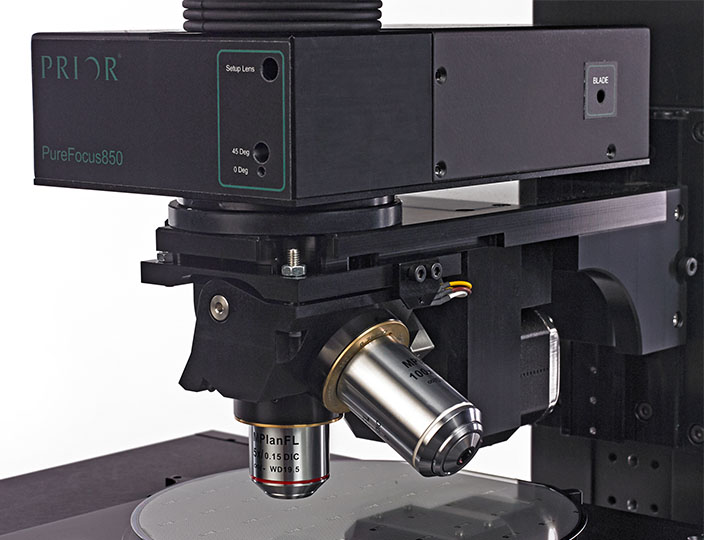
We’ve used one of Prior’s motorized stages to scan around the combined samples to demonstrate that, regardless of the sample material, its structure and different levels of reflectivity, the PureFocus850 maintains focus on the sample.
How Hardware Autofocus Works
Hardware autofocus systems contain either an LED or laser diode that emits light onto the sample, reflected by a dichroic mirror (represented by the green line on the diagram below). The signal is collected and detected by a sensor (shown by the blue line on the diagram). When the sample moves out of focus, the system detects a defocus signal and adjusts accordingly. To determine focus direction, the system fills only half of the objective's back aperture, allowing for directional detection of focus changes.
The imaging process is unaffected by hardware autofocus: Prior’s PureFocus850 can be positioned anywhere in the microscope’s infinity space and will allow transmission of all visible light wavelengths, enabling it to be used with fluorescence microscopy and ensuring that image color balance is unaffected. Color cameras typically do not detect the weak 850 nm wavelength light emitted by the PureFocus, and any stray light that may be detected by higher-end cameras can easily be blocked by installing a shortpass filter.
Key Applications for Hardware Autofocus
There are a wide range of applications and uses for hardware autofocus in both life science and industrial microscopy.
1. Time lapse imaging
-
Focus is maintained on cells over a 24-48 hour period to look for changes in morphology or changes in the expression of different proteins.
-
Medical devices and microfluidics where samples are dynamic and temporal resolution is necessary.
-
Microfluidics systems, organoids or other life science samples with depth, where contrast-based autofocus will not be able to locate the same image plane at each time point.
2. Industrial Inspection
-
In a laboratory setting or above an inline processing routine, where throughput is critical.
-
Autofocus is ideal for semiconductor inspection because of the large sample sizes and complex surfaces.
Major Advantages of Prior Scientific’s Hardware Autofocus
Three key advantages of the PureFocus850 are:
1. Speed and Efficiency
-
Up to 95% reduction in scanning times compared to traditional methods
-
Rapid focus capture without multiple image requirements: reduces volume of data for storage
2. Sample Versatility
-
Sample-agnostic operation
-
Effective with low-contrast samples
-
Works with sparse or diffuse fluorescence expressions
3. Resistance to Environmental Factors
-
Maintains focus despite thermal changes around the microscope: important for quality in time-lapse imaging
-
Minimal impact on live cell environments as light sources used for imaging can be quite weak, which protects the cells
The PureFocus850 also offers a number of specific benefits related to its features:
Signal Processing Modes
Prior’s PureFocus850 allows for processing samples with variations in height – such as semiconductor wafers. The system has two configurations which users can select to fit their requirements best:
1. Slice Mode: Focuses on a specific point at the center of the field of view.
-
Ideal for flat planes, tilted and undulating surfaces.
-
Best-suited to glass slides, culture dishes and well plates.
2. Line Mode: Takes weighted averages of signals detected from across the field of view.
-
Better for samples with surface variations or weak reflectance.
-
Provides more consistent focus across uneven surfaces.
-
Best suited to industrial samples, semiconductor wafers or lab-on-a-chip devices.
Optical Path Integration
The Prior PureFocus system mounts in the microscope's infinity space, offering flexible positioning options. This ensures that the PureFocus can be positioned behind the objective in fluorescence microscopes to avoid the autofocus laser signal being blocked, or in front of the tube lens in darkfield microscopes to ensure maximum suppression of stray light. It can even be positioned outside of the main optical axis for systems with space or path length constraints.
Advanced Protection Features
The Servo Limit Function represents a crucial safety advancement in autofocus technology. This system establishes fixed movement ranges relative to where the autofocus is first activated, effectively preventing objective crashes and protecting both samples and equipment. Particularly valuable when working with multiple samples, the function facilitates smooth movement between adjacent specimens while maintaining precise focus control.
Dynamic Laser Power Adjustment
The system's ability to automatically adjust laser power based on sample reflectivity represents a significant advancement in autofocus technology. This dynamic adjustment maintains optimal signal-to-noise ratios across varying sample types and conditions. The system continuously monitors and adapts to changes in material properties, ensuring consistent performance regardless of sample characteristics.
Interface Correction
Advanced interface correction methods form a crucial part of the system's capabilities. The technology effectively manages multiple reflections from sample layers, demonstrating sophisticated discrimination between different interfaces. This precise control allows the system to identify and focus on correct interfaces while avoiding false focus on unwanted surfaces, ensuring accurate and reliable imaging across complex sample structures. These features are essential for using the PureFocus850 with biological samples on slides or in well plates.
System Performance and Safety Features
Signal Quality Management
The system employs comprehensive signal quality optimization techniques to ensure reliable performance. Through sophisticated signal-to-noise optimization and targeted filtering of interference sources, the autofocus maintains consistent accuracy. Mathematical correction algorithms further enhance signal clarity, providing robust focus maintenance across various imaging conditions.
Sample Detection
The integration of comprehensive safety features represents a key aspect of the system's design. Advanced crash prevention systems work in conjunction with continuous signal monitoring to protect both samples and equipment. If the signal intensity exceeds or drops below an allowed threshold, the autofocus will automatically deactivate.
Conclusion
Hardware-based autofocus systems represent a significant advancement in microscopy automation. Their ability to rapidly and accurately maintain focus across various sample types and conditions makes them invaluable tools in both research and industrial applications. With continued development of features like dynamic laser power adjustment and sophisticated signal processing, these systems are becoming increasingly adaptable and essential for modern microscopy applications.
The PureFocus850 from Prior Scientific provides real-time focus control for most infinity-corrected optical systems and is suitable for both life science and industrial samples. Learn more about the PureFocus850 or request a demonstration.